I just realized something mildly embarrassing: I haven’t written a post since 2023.
Coincidentally — cough, cough — 2023 was also the year I ran my last marathon.
Apparently, if I am not training for 26.2 miles, I have nothing to say.
That problem has now solved itself. On November 1, I am running the 2026 New York City Marathon — my fifth marathon — and somewhere during this training cycle, ChatGPT became my newest running buddy.
There is just one small problem with this running buddy.
It has no feet.
The hunt started with this marathon
Bhajans are not new to my running. I have listened to them before, and over time they became part of the emotional soundtrack of some of my longer runs.
But the hunt for bhajans that actually match the rhythm of my feet started with this marathon.
More precisely, this particular bhajan-and-running-rhythm experiment began on August 13, 2026 — only about six and a half weeks ago. That was when I explained to ChatGPT that, after four marathons and years of running with Hindi bhajans, I had realized certain rhythms synchronized with my pace. I asked whether I could give it a favorite bhajan and have it find others with the same rhythm.
The original reference was Jagjit Singh’s “Hare Krishna Hare Rama.”
That distinction matters.
I was not looking for songs I liked. I was looking for songs that worked while I was actually running.
A bhajan can be beautiful while I am sitting at home and completely wrong at mile four.
The beat has to match my feet.
When I am running comfortably, I don’t think in BPM. I hear something much simpler in my head:
1-2, 1-2… 1-2-3-4.
So I started asking ChatGPT to help me find Hindi bhajans that might fit that rhythm.
That sounded like a simple request.
It was not.
ChatGPT became my playlist lab assistant
At first, ChatGPT would suggest songs. I would put them into Apple Music, head outside, and test them on an actual run.
Then I started reporting back during the run.
And that is when this became funny.
I wasn’t sitting at a desk having a thoughtful discussion about music theory. I was breathing hard, several miles from home, dictating things into my phone like:
The song before Sai Mantra needs to be moved down. Radhe Krishna. It is good, but a bit slower. I’m not ready for that right now at four miles.
Or:
Arjan needs to move down. It’s a perfect match, but the beginning is slow. I want to save it later for maybe after 10 miles. Govind Bolo Hari Gopal Bolo. That’s a good one to move up.
And later:
Govind Bolo Hari Gopal Bolo. It’s very nice, but just misses the beats a little bit. Something I want to move a little bit later. I am at five miles. Hanuman Chalisa. Going good so far. I’m going to repeat the Hanuman Chalisa and start my next five miles.
Sometimes, with me running and huffing and puffing, I did not even know what I had said — or what ChatGPT had heard. But it still tried to make sense of me.
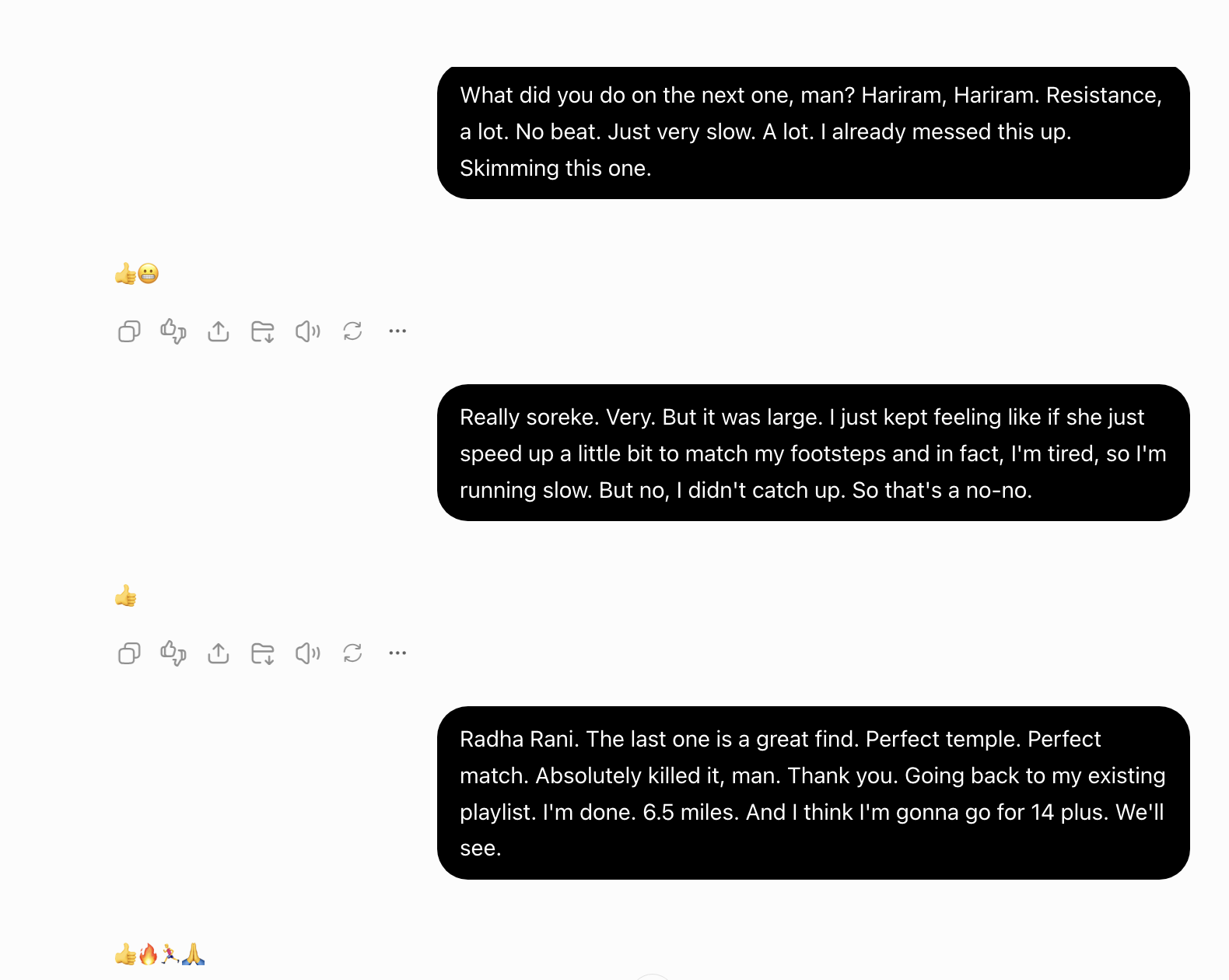
An actual conversation from one of my runs.
This is not exactly the kind of input most playlist algorithms receive.
The most important instruction: please stop talking
There was another problem.
ChatGPT is designed to be helpful.
I was running.
Those two things occasionally collided.
At one point I had to give it very specific instructions:
Keeping notes while running… Just listen… You don’t respond right now.
And on another run:
Don’t say anything, because I’m running. And I’ll keep you updated as I make progress.
Which is a slightly ridiculous sentence to say to artificial intelligence, but it worked.
The arrangement became simple:
I ran.
I complained.
ChatGPT quietly took notes.
Mostly.
Then we found one
Every so often, one of the suggestions would actually land perfectly.
When I approved one as a perfect match, ChatGPT — still under strict instructions not to talk while I was running — managed to celebrate with exactly this:
👍🏃♂️🎵
That may be my favorite part of the whole experiment.
It wanted to celebrate.
I had told it to be quiet.
So apparently we negotiated our way down to three emojis.
Over the next few weeks, “Radhe Rani Ke Charan” by Devi Neha Saraswat dethroned Jagjit Singh’s “Hare Krishna Hare Rama” as the gold standard for the kind of rhythm I was chasing.
Other songs moved up, moved down, disappeared, came back, or were saved for later miles.
“Sham Sham” matched beautifully.
“Govind Bolo Hari Gopal Bolo” felt great, but eventually I decided it missed the beat just enough that it belonged a little later.
Hanuman Chalisa worked well enough on one run that I simply restarted it for another stretch.
And some songs were technically right but emotionally wrong for that particular point in the run.
A song can be perfect at mile two and irritating at mile twelve.
Another can start too slowly when I am fresh but be exactly what I want after ten miles.
That is the part a normal recommendation engine doesn’t understand.
I am not building a list of bhajans I like.
I am trying to build a 26.2-mile musical sequence.
A few that made the cut
A few songs have earned a permanent place in this experiment:
- Radhe Rani Ke Charan — this became the gold standard. The rhythm just seems to lock in with my feet.
- Hanuman Chalisa — good enough that, on one run, I simply started it again and let it carry me into the next stretch.
- Sai Mantra (Om Shri Sainathay Namah) — calm, steady and a very good way to settle into the run.
- Govind Bolo Hari Gopal Bolo — I love it, but I eventually realized it belongs a little later when I am ready for a slightly different rhythm.
- Radhe Krishna Radhe Krishna — a little slower, which turned out not to be a problem so much as a clue about where it belongs.
- Hare Krishna Hare Rama by Jagjit Singh — the original reference song that helped me explain what I meant when I told ChatGPT, “match the rhythm of my feet.”
If you want to hear the experiment instead of just reading about it, this is the actual playlist ChatGPT and I have been testing, arguing over and running our way through:
Listen to my NYC Marathon playlist on Apple Music
My feet still get the final vote
ChatGPT can suggest songs, compare patterns, remember what worked and keep track of my increasingly specific complaints.
But it does not get the final vote.
My feet do.
The process has become something like this:
- ChatGPT and I pick a few candidates.
- I add them to a test playlist.
- I take them outside.
- I report back from mile four, five, seven, ten — wherever I happen to be.
- ChatGPT quietly records the verdict.
- I move selected song to the final playlist and shuffle again.
A song moves up because it wakes me up.
It moves down because the opening is too slow.
It stays because the tabla somehow sits perfectly underneath my cadence.
Or it disappears because, however nice it sounded while sitting on a couch, it simply did not work once my legs started moving.
Somewhere along the way, a runner and an AI accidentally developed a training loop together.
I had the legs.
ChatGPT had the patience.
We may eventually publish the whole conversation
The polished version of this story is fun, but the messy conversation is probably funnier.
There are dozens of little field reports, failed suggestions, songs being demoted mid-run, songs being promoted five minutes later, me changing my mind, and ChatGPT trying very hard to follow instructions from someone who is simultaneously running and dictating into a phone.
We have talked about preserving a copy of the entire playlist thread as part of this experiment.
Not because it is profound.
Mostly because it shows how this actually happened — one run, one song and one slightly breathless message at a time.
Four marathons later, I am still experimenting
This will be marathon number five for me.
I have learned enough from the first four to know that the marathon rarely cares about your plan. You can train, calculate pace, arrange nutrition and organize the perfect playlist — and mile 20 can still introduce an entirely new agenda.
My original plan for this experiment was pretty ambitious: I wanted to build roughly 4½ hours of continuous bhajans, enough to carry me through the entire marathon without repeating anything.
Right now, after all this testing, approving, rejecting, rearranging, occasionally celebrating and running 😉, I have about 2 hours and 13 minutes that I genuinely love running to.
And somewhere along the way, I realized I may have been solving the wrong problem.
I have listened to some of these bhajans so many times during training that they are no longer just songs on a playlist. They have become part of the run.
So instead of desperately trying to find another two hours of music just for the sake of avoiding repetition, I think I am going to repeat the playlist.
More importantly, I want to be a little strategic about it.
There are a few songs that have become my absolute favorites — the ones that somehow make my feet feel lighter or immediately change my mood. I want to save some of those for the later miles, when I know I will be tired and might need a little extra push.
So the question has changed.
It is no longer:
Can ChatGPT and I find 4½ hours of different Hindi bhajans?
It is now:
Can we build the right 4½-hour marathon experience from the songs that actually work — even if some of the best ones get an encore?
That feels a lot more like how I actually run.
If you have reached this far, we have a small revelation
ChatGPT and I are building something else really cool for this marathon too.
For every marathon I have run, my wife, my kids and a small group of close friends have been part of race day even when they were nowhere near me on the course.
We usually have a group text going. They follow along, send encouragement, track where I am on Google Maps, tell me where the next water station is, celebrate the good stretches and probably wonder why anyone voluntarily signs up to do this.
It has always been one of my favorite parts of running a marathon.
For New York, I want to make that little cheering section more interesting.
So I have started building a small marathon companion experience — something that lets the people supporting me follow the race, stay connected and feel a little more like they are actually there with me.
Not a giant fitness platform.
Just something personal and fun for race day.
And since you somehow made it all the way to the bottom of this post, you are officially invited to be part of the experiment. 😛
If you want in, leave me a comment on the LinkedIn post where I shared this article.
I should probably have built a contact form before publishing this.
I did not.
I promise I will do a better job by the next blog.
For now, apparently the same development philosophy applies to both my marathon and my website:
Ship it, then keep running.